Most NZ chemical plants running air-operated double diaphragm (AODD) pumps inherited that infrastructure. It works. But “works” and “optimised” are two very different things, and the gap between them is where operational budgets quietly disappear.
Compressed air is expensive to produce, costly to maintain, and notoriously inefficient as a power source for continuous-duty pumping. Add compressor servicing, FRL maintenance, and the downtime from a diaphragm failure with no spare on the shelf, and those running costs for chemical transfer pumps in NZ add up faster than most operations managers realise.
Electric-operated double diaphragm (EODD) pump technology has changed what’s possible. But the right pump still depends on your application, your infrastructure, and how your plant actually operates day-to-day.
Read on for a straight breakdown of AODD vs EODD pumps and a practical selection guide built for NZ chemical operations, or contact us for more information.
Key Takeaways
Double-diaphragm pumps in NZ are positive-displacement pumps, meaning they move a fixed volume of fluid per cycle, regardless of pressure. Two flexible diaphragms alternate, each pulling fluid in on the intake stroke and pushing it out on the discharge stroke. The result is a continuous flow that doesn’t need priming, doesn’t need mechanical seals, and won’t be damaged by running dry.
That last point matters more than it sounds in chemical transfer. Sumps run low. Tankers empty unexpectedly. Batches finish mid-shift. While most pump technologies punish you for those moments, double diaphragm pumps don’t.
They’re also built to handle the fluids that other pumps struggle with: corrosive acids, viscous slurries, shear-sensitive chemicals, and media loaded with suspended solids. With the right wetted materials, such as PTFE, PVDF, stainless steel, or polypropylene, a double diaphragm pump can be configured for almost any chemical transfer duty you’re likely to encounter in an NZ processing plant.
It’s why they’re a staple across chemical processing, food and beverage production, wastewater treatment, and general manufacturing here in New Zealand. When it comes to air-operated vs electric diaphragm pump selection, the differences run deeper than just power source.
An air-operated double diaphragm (AODD) pump uses compressed air as its power source. Air enters the centre section of the pump and shifts alternately between the two diaphragm chambers, pushing one diaphragm forward to discharge fluid while pulling the other back to draw fluid in. A simple air valve controls the switching, while no electricity is required at the pump itself, just a compressed air hose gets you up and running.
AODD pumps are intrinsically safe in hazardous environments. Because there’s no electrical connection at the pump, they can operate in Zone 0 and Zone 1 classified areas without the cost premium of full ATEX certification. For NZ chemical plants handling flammable solvents, fuels, or volatile compounds, that’s a meaningful compliance advantage.
They’re also genuinely portable. A trolley-mounted AODD pump can be moved between locations, connected to an air hose, and operational in minutes, making it the go-to for drum emptying, IBC transfers, tanker unloading, and temporary transfer duties where a fixed installation isn’t practical.
When it comes to fluid handling, few pump types are as versatile. AODD pumps handle:
Air-operated double diaphragm (AODD) pumps are often chosen partly because they appear cost-effective up front. They don’t require a motor, electrical installation, or a variable speed drive; just connect to your existing compressed air network and go. Although that compressed air network is carrying costs that most operations managers never fully account for, the opportunity to reduce compressed air costs in your chemical plant is often bigger than it first appears.
Generating compressed air is one of the most energy-inefficient processes in an industrial plant. A significant portion of the electrical energy going into your compressor is lost as heat before it ever reaches the pump. In practice, only a fraction of the electrical energy going into a compressor ever reaches the pump as useful work. The rest is lost as heat during compression and distribution.
Then there’s the infrastructure around the compressor itself. Filter-regulator-lubricators (FRLs), air dryers, distribution pipework, and compressor servicing all entail ongoing costs that rarely appear in the pump’s maintenance budget. They’re just absorbed into plant overheads, which lie invisible until something fails.
Noise is another cost that often goes unnoticed until it becomes a compliance problem. A single AODD pump in a confined pump room can generate significant noise levels. Run several simultaneously, and you’re regularly pushing past the 85 dB(A) eight-hour threshold that triggers occupational health requirements under New Zealand workplace regulations. And if your pumps are running six, eight, or ten hours a day on continuous chemical transfer duties, those inefficiencies compound every single shift.
This is exactly the scenario that led one chemical processing facility to reconsider its entire pump fleet, and the results were hard to argue with.
In Graco’s double diaphragm pump chemical application case study, a chemical processing plant evaluated the performance of electric double-diaphragm technology against its existing AODD setup. The findings across energy consumption, operational reliability, and maintenance burden made a compelling case for switching, not as a wholesale rip-and-replace, but as a strategic upgrade for their highest-duty transfer points.
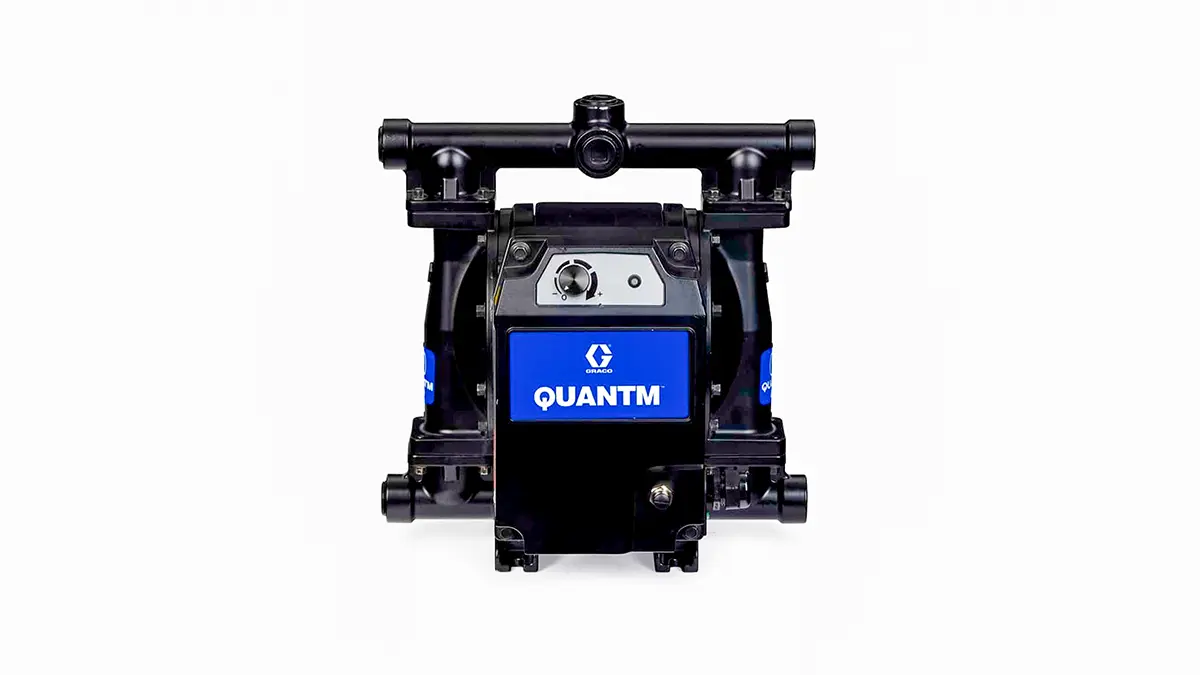
The numbers behind the technology back it up. Graco’s QUANTM electric diaphragm pump in NZ delivers up to 80% reduction in pumping energy costs compared to a comparable AODD pump running the same duty cycle.
Noise levels dropped significantly, too. Removing compressed air from the equation eliminates the characteristic AODD exhaust noise, bringing pump rooms back under the 85 dB(A) threshold without additional mitigation measures.
For NZ chemical plants running multiple AODD pumps in continuous duty, the cumulative impact across the fleet is substantial. The question isn’t really whether the savings are real. Graco’s case study data confirms they are. The question is which of your transfer points would benefit most from making the switch.
That starts with understanding how the QUANTM actually works.
An electric-operated double diaphragm (EODD) pump moves fluid the same way an AODD does, with two alternating diaphragms, positive-displacement action, self-priming, and sealless operation. Instead of compressed air, an electric motor converts rotary motion into the reciprocating stroke that pushes the diaphragms back and forth.
That shift in power source significantly changes the performance profile.
Because flow rate is directly tied to motor speed rather than air supply pressure, EODD pumps deliver consistent, controllable output. Speed up the motor, increase the flow. Slow it down, reduce it. There’s no air valve stall, no pressure drop across a distribution line affecting performance, and no compressor fluctuation carrying through to your process.
The Graco QUANTM takes that further with some genuinely useful engineering. Its FluxCore motor delivers up to eight times more continuous torque at low speeds than conventional motors, which means stable, precise flow even at the lower end of the speed range where many electric pumps struggle. The integrated smart controls adjust speed automatically to aid priming and prevent dry-run cavitation damage, removing a failure mode that catches plenty of operators off guard.
One feature worth calling out specifically: the QUANTM is the only electric diaphragm pump designed to stall safely under back pressure. If you close a downstream valve or deadhead the pump, it stops without damage and without additional pressure sensors or safety controls. That’s a meaningful simplification for chemical plant installations where process conditions change frequently.
From a practical installation standpoint, the QUANTM plugs directly into a standard 110V–240V supply, or 380/480V for larger installations, with no additional wiring or compressed air infrastructure needed. It’s lighter and more compact than most pumps in its class, and the no-muffler design ensures full leak containment, keeping any harmful vapours from becoming airborne. For HACCP-regulated environments and chemical plants with strict containment requirements, that’s not a minor detail.
Quieter, cleaner, more controllable, and considerably cheaper to run. For fixed-installation, continuous-duty chemical transfer in an NZ plant, the Graco QUANTM excels.
Explore our practical chemical pump selection guide for NZ operations below.
| Factor | AODD | EODD |
| Power source | Compressed air | Electric motor (110V–480V) |
| Energy efficiency | Lower, significant compressor losses | Up to 80% more efficient than AODD |
| Upfront cost | Lower capital cost | Higher upfront, faster ROI |
| Running cost | Higher ongoing compressed air spend | Considerably lower long-term |
| Hazardous area use | Zone 0/1 without ATEX premium | Zone 1/2 with ATEX certification |
| Portability | High. Mobile, no electrical connection | Fixed installation |
| Flow control | Limited. air pressure dependent | Precise variable speed via integrated controls |
| Noise levels | Higher, can exceed 85 dB(A) | Quieter, typically below 85 dB(A) threshold |
| Maintenance | Diaphragms, valve balls, seats, FRL servicing | Lower overall, no air valve or compressor servicing |
| HACCP suitability | Good with correct configuration | Excellent, no-muffler leak containment |
Choose an AODD pump when:
Choose an EODD pump when:
If you’re genuinely unsure which category your application falls into, that’s exactly the conversation to have with Pumpworks. As one of New Zealand’s authorised Graco distributors, we regularly work through these decisions with NZ operations teams, considering your duty cycle, fluid chemistry, existing infrastructure, and compliance obligations before making any recommendations.
Choosing between AODD and EODD technology isn’t always a straightforward call. It depends on how your plant operates, what you’re transferring, how many hours your pumps run, and what your compliance obligations look like. Get it right, and you’ve got a reliable, cost-effective transfer system that earns its keep for years. Get it wrong, and you’re managing avoidable downtime, inflated energy bills, and maintenance headaches that eat into production time.
That’s why the conversation matters as much as the product.
Pumpworks is one of New Zealand’s authorised Graco distributors. We stock both the Graco Husky chemical transfer pump range and the NZ QUANTM electric diaphragm pump, with genuine OEM parts available for immediate dispatch. But beyond the hardware, we offer a full suite of in-house services. From helping you select the right pump for your specific application to building a preventive maintenance plan that keeps your operation running without interruption, we’re invested in the outcome, not just the sale.
Whether you’re evaluating a switch to energy-efficient chemical pumps in NZ, speccing pumps for a new installation, or simply trying to get more out of your existing fleet, let’s have a conversation.
Get in touch with the Pumpworks team today to discuss your chemical transfer requirements, or ask us about our maintenance planning service for NZ industrial operations today!

Address: 16/10 Olive Road, Penrose, Auckland 1061
Phone: 0800 215 104
Email: [email protected]
SEO By 

